Loading page…
Private online guidance for important decisions · London & UK-wide

Istikhara vs Astrology
Istikhara vs Astrology: What Is the Difference?
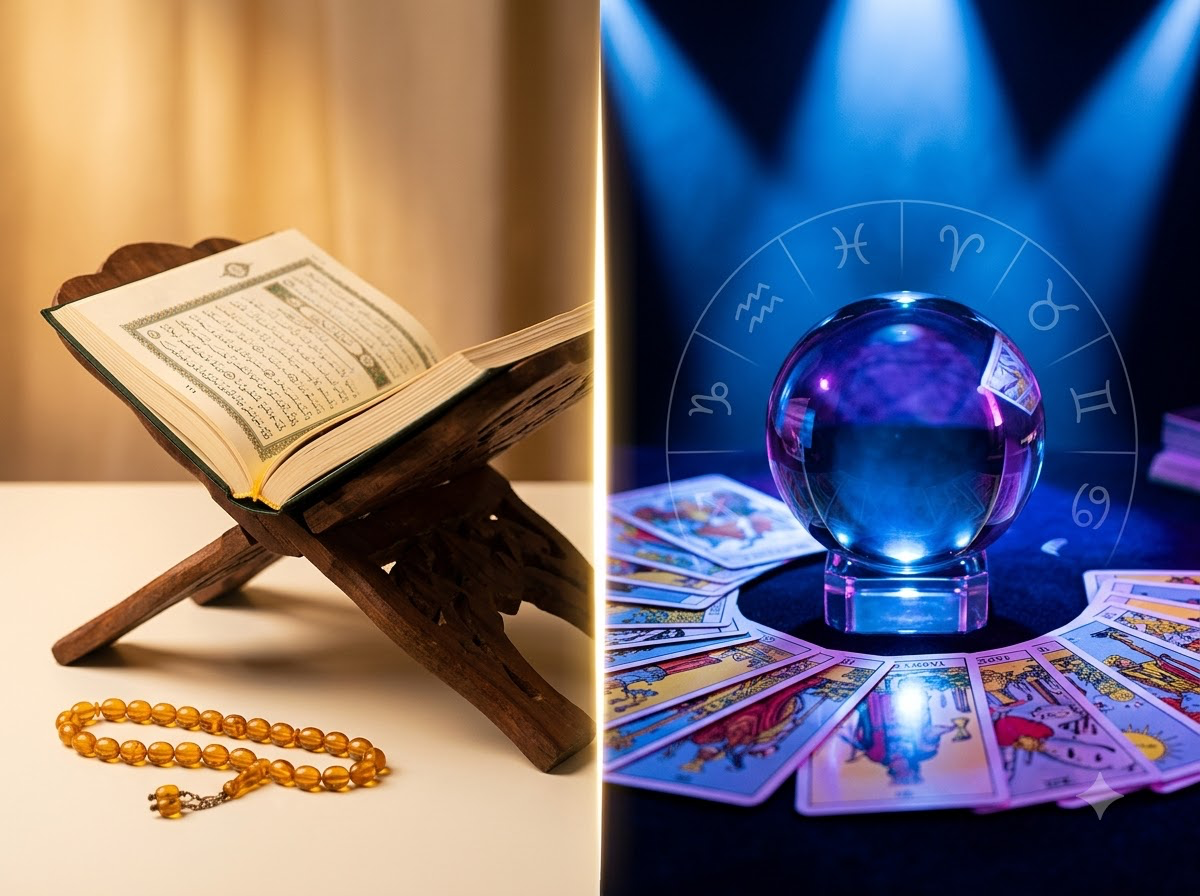
Istikhara and astrology are sometimes confused because both are consulted when someone is uncertain about a decision. They are not the same thing, do not work the same way, and are not interchangeable. This page sets out the difference clearly.
Islamic Istikhara UK
Two different things, clearly explained
Trusted online guidance, UK-wide
Rooted in Islamic sources, delivered with respect and care.
Fully confidential Islamic sources UK-wide, online
Answer first
Are Istikhara and astrology the same thing?
No. Istikhara is a prayer asking Allah for guidance; astrology claims to forecast events or character from the position of stars and planets. They come from unrelated frameworks.
This site provides information about Istikhara and a way to request it privately. It does not offer astrology, horoscopes, star-sign readings, kundli matching, or any form of fortune-telling, and it never will. We make this distinction clearly because the two are sometimes presented side by side online, which can be genuinely confusing for people seeking Islamic guidance for the first time.
The difference between Istikhara and astrology is not simply one of branding or cultural origin. It is a difference of category. One is an act of worship directed to Allah, asking for what is good. The other is a predictive system that claims to read the future from the movement of celestial bodies. Understanding this distinction matters for anyone trying to make a decision with sincerity and clarity.
Definitions
What each one actually is
Istikhara
A short Islamic prayer and dua asking Allah for guidance on a specific, permissible decision. It makes no claim to reveal the future and does not predict a fixed outcome. The word itself comes from the Arabic root meaning to seek what is good or best, and it is taught directly through authentic hadith of the Prophet Muhammad (peace be upon him).
Astrology
A practice that interprets the position of stars and planets to make claims about personality, compatibility, or future events. It is not part of Islamic worship and has no basis in the Quran or Sunnah. While culturally widespread in many communities, mainstream Islamic scholarship treats it as a form of seeking knowledge of the unseen that belongs to Allah alone.
Side by side
Key differences between Istikhara and astrology
| Aspect | Istikhara | Astrology |
|---|---|---|
| Source of guidance | Prayer directed to Allah | Position of stars and planets |
| What it claims | Asks for what is good; makes no prediction | Claims to forecast events or traits |
| Religious standing | An established act of Islamic worship | Not part of Islamic practice |
| Certainty offered | None — a request, not an answer | Presented as a reading or forecast |
| Knowledge of the unseen | Does not claim access to hidden knowledge | Claims to reveal hidden information about the future |
| Basis in Islamic texts | Taught in authentic hadith | No basis in Quran or Sunnah |
| Who can perform it | Any practising Muslim | Claims to require special interpretive skill |
Why it matters
Why the distinction matters
People searching online for spiritual guidance sometimes use the words loosely, and search results can blur the two together. Being precise matters here because Istikhara and astrology sit in genuinely different categories — one is prayer, directed to Allah, with no claim to reveal hidden knowledge; the other is a predictive system with no basis in Islamic practice. Conflating them does a disservice to people looking for either one.
The confusion is not always the searcher’s fault. In many South Asian and Middle Eastern communities, the language around guidance, spiritual consultation, and decision-making can overlap in everyday conversation, even when the underlying practices are entirely different. Someone who grew up hearing relatives mention both Istikhara and horoscopes in the same breath may not immediately realise they are categorically distinct. This page exists to make that distinction clear, without judgement of anyone who arrived here with the terms mixed up.
There is also a practical concern. When the two are confused, people may approach Istikhara with the expectations of astrology, hoping for a specific prediction, a compatibility reading, or a guaranteed answer. This misunderstanding can lead to disappointment, anxiety, or a sense that the prayer did not work, when in reality the prayer was never designed to function that way. Istikhara is not fortune-telling; it is a sincere request for guidance, and understanding that difference shapes how you approach it and what you take from the experience.
The Islamic view
Astrology and fortune-telling in Islam
A well-established position
Mainstream Islamic scholarship treats seeking predictions from fortune-tellers and diviners seriously. It is reported in Sahih Muslim (2230) that the Prophet Muhammad (peace be upon him) said that a person who visits a diviner and asks about something will have their prayers not accepted for forty nights. Istikhara is a separate, established act of worship, taught directly by the Prophet, and is not affected by this ruling. The distinction rests on a fundamental difference: Istikhara asks Allah for what is good, while fortune-telling and astrology claim to access knowledge of the unseen that belongs to Allah alone.
Common confusion
How the confusion arises
Several factors contribute to the ongoing confusion between Istikhara and astrology. The first is language. In many communities, the word for seeking guidance is used broadly, covering everything from prayer to consulting an astrologer to reading a horoscope. When these different activities share vocabulary, it becomes easy to assume they share substance, even when they do not.
The second factor is the internet itself. Search engines group results by topic similarity, and someone searching for Islamic guidance on a decision may see results for astrology, kundli matching, and horoscope readings alongside genuine Istikhara resources. This proximity in search results creates an implied equivalence that does not exist in reality. It is one reason we have written this page: so that people can find a clear explanation of the difference rather than having to piece it together from scattered and sometimes contradictory sources.
The third factor is commercial. There are individuals and websites that deliberately blend Islamic language with astrological or fortune-telling services, using terms like Islamic astrology or spiritual reading alongside references to Istikhara. This can be misleading, particularly for people who are unfamiliar with the specific Islamic teaching on what Istikhara is and how it works. If a service offers Istikhara alongside horoscope readings, tarot, or zodiac compatibility assessments, that is a signal to proceed with caution.
What Istikhara is not
Istikhara is not fortune-telling
Not a prediction
Istikhara does not predict what will happen. It asks Allah for what is good and to turn you away from what is harmful. The future remains unknown, and the prayer does not claim otherwise.
Not a compatibility score
Unlike zodiac or kundli matching, Istikhara does not produce a numerical score, a compatibility rating, or a pass-or-fail verdict on a relationship or decision.
Not a reading
Istikhara does not involve interpreting symbols, objects, celestial positions, or any external signs in a systematic way. It is a prayer, not a diagnostic tool for life events.
A better understanding
What Istikhara actually offers
When you understand that Istikhara is not astrology and not fortune-telling, you can approach it for what it actually is: a sincere, humble request to Allah for guidance on a decision you are genuinely uncertain about. The prayer does not promise a dramatic dream, a clear sign, or an immediate feeling of certainty. What it offers is a framework for approaching a difficult decision with sincerity, humility, and trust in Allah’s knowledge of what is best for you.
This is a quieter, less dramatic form of guidance than what astrology or fortune-telling typically promises. There is no chart to consult, no reading to decode, no prediction to wait for. Instead, there is a prayer, followed by continued reflection, consultation with people you trust, and attention to how circumstances unfold. For many people, the value of Istikhara lies precisely in this: it grounds a decision in faith rather than anxiety, and it removes the pressure to know the future before choosing.
Islamic guidance through Istikhara works alongside your own reasoning, not in place of it. You are still expected to research your options, consult knowledgeable people, and think carefully about the practical realities of your decision. Istikhara adds a spiritual dimension to that process, asking for Allah’s help in reaching a good outcome. It does not shortcut the process or replace the hard work of thinking things through.
If you are here for guidance
Looking for Istikhara?
If you arrived here searching for an “Islamic astrologer”, an “online astrologer”, or similar, you are likely looking for exactly the kind of guidance this site provides — a considered, prayer-based approach to a decision, without predictions or horoscopes. The difference between Istikhara and astrology is not a technicality; it shapes the kind of guidance you receive and how you should approach it. Learn more about what Istikhara actually is, or go straight to requesting private guidance.
If you are facing a specific decision about marriage, career, business, or another area of life, we have dedicated pages that explain how Istikhara applies to each situation. These pages are written with the same commitment to honesty and clarity: no exaggerated claims, no guaranteed outcomes, and no blurring of the line between prayer and prediction.
Frequently asked questions
Istikhara vs astrology FAQs
Is Istikhara a type of astrology?
No. Istikhara is a prayer asking Allah for guidance on a decision. Astrology claims to read the future or a person's character from the position of stars and planets. They come from entirely different frameworks and neither works like the other. Istikhara is rooted in Islamic worship, while astrology is a practice that has no basis in Islamic teaching and is treated by mainstream scholars as something Muslims should avoid.
Do people search for "Islamic astrologer" looking for Istikhara?
Sometimes, yes — the terms get used loosely in everyday conversation, particularly in South Asian communities where both concepts are culturally familiar. If that is why you are here: this site does not offer astrology, horoscopes, or fortune-telling in any form. It offers Istikhara, the Islamic prayer for guidance, which works differently. The confusion is understandable, and we would rather explain the difference honestly than leave it unclear.
What does Islam say about astrology and fortune-telling?
Mainstream Islamic teaching holds that seeking predictions from fortune-tellers, diviners, or astrologers is not permitted, based on hadith that treat this practice seriously. The concern is with claiming knowledge of the unseen, which belongs to Allah alone. Istikhara is a separate, established act of worship and is not affected by this ruling, because it asks for guidance rather than claiming to reveal hidden information.
Can Istikhara tell me my horoscope or zodiac compatibility?
No. Istikhara does not produce a horoscope, a star sign reading, or a compatibility score. It is a request for guidance about a specific decision, not a general reading about your life or personality. If someone offers you an "Islamic horoscope" or claims to combine Istikhara with zodiac readings, that is not a service grounded in Islamic teaching.
Why does this page exist?
Because people genuinely searching for Istikhara sometimes land on astrology sites by mistake, and vice versa. Search engines often group these topics together because users search for them in similar language. We would rather explain the difference clearly than let the confusion continue, so that people looking for Islamic prayer-based guidance can find it without wading through unrelated content.
Can an astrologer perform Istikhara for me?
Istikhara is a prayer performed by a Muslim, directed to Allah, following a specific method taught by the Prophet Muhammad (peace be upon him). It does not require any special powers, astrological knowledge, or divination skill. Anyone who frames Istikhara as requiring astrological expertise is mixing two unrelated practices. A knowledgeable, practising Muslim can perform Istikhara on your behalf if you request it, but this has nothing to do with astrology.
Is numerology the same as Istikhara?
No. Numerology, like astrology, is a practice that assigns meaning to numbers in ways that are not part of Islamic teaching. Istikhara does not involve numbers, calculations, birth dates, or any numerical system. It is a straightforward prayer asking Allah for guidance, and it should not be confused with numerological readings or similar practices.
What if someone claims to offer both Istikhara and astrological readings?
This is a sign to be cautious. Istikhara and astrology are based on fundamentally different principles. Istikhara is directed to Allah and makes no claim to reveal hidden knowledge; astrology claims to read the future from celestial positions. Offering both suggests a lack of clarity about what each one is. If you are looking for genuine Istikhara guidance, it is better to seek it from someone who understands the prayer on its own terms.
Does Istikhara involve reading palms, tarot cards, or tea leaves?
No. Istikhara involves none of these practices. It is a two-rakah prayer followed by a specific dua taught by the Prophet Muhammad (peace be upon him). There is no physical reading of any kind, no interpretation of symbols on cards or in cups, and no claim to access hidden information through objects. These are entirely separate practices that fall under fortune-telling, which Islamic teaching distinguishes clearly from prayer.
Is it harmful to confuse Istikhara with astrology?
It can be, in two ways. First, someone looking for genuine Islamic guidance may end up with an astrologer who cannot provide it, and may receive advice that has no basis in Islamic teaching. Second, the confusion can lead people to treat Istikhara itself as a form of fortune-telling, expecting it to produce predictions or guaranteed outcomes, which misrepresents what the prayer is and can cause disappointment or anxiety when it does not work that way.